Environment
By Libby Mayne
Published: 27th February 2025
Hurricane Helene made landfall in Florida’s Big Bend on 26th September 2024, where it then headed towards Tennessee, Georgia, and North Carolina. Helene rapidly intensified from a Category 1 to a Category 4 storm in just 24 hours. With six states declaring Helene a major disaster, the tropical cyclone drastically changed the landscape of south-eastern American regions.
As the deadliest storm to strike mainland US in almost 20 years, Helene sustained winds of 140mph, whilst unleashing downpours on slopes in recovery from days of heavy rainfall. Because of the mountainside terrain in North Carolina, the rain resulted in an unimaginable flash flooding and destructive mudslides.
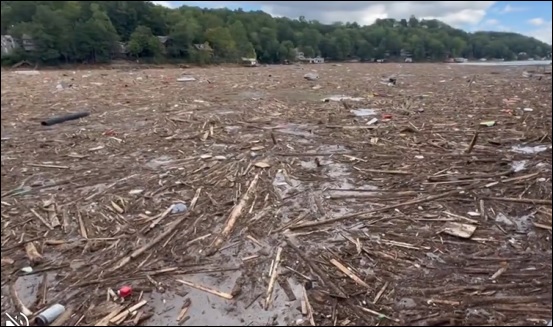
Figure 1: Photo posted on Twitter (X) of what’s left of homes in Chimney Rock, North Carolina from Hurricane Helene, 2024
Chimney Rock is located in Rutherford County, North Carolina. The village was almost entirely washed away by Helene, leaving citizens without power, water, phone lines and shelter. The USA Today Network spoke to Tracey Stevens who worked at Chimney Rock Brewery. Stevens’ brewery no longer remains due to the extensive damage; she states, ‘what was once a town is now a river.’ Alongside Chimney Rock Brewery, many buildings and homes were physically swept away and destroyed by the Broad River.
Scientific American spoke to civil engineer at the University of Memphis, Janey Camp to understand the economic impact on North Carolina counties. Camp notes, ‘these are not areas that get a lot of attention and investment for resilience and planning and improved infrastructure’. Census data from 2022 indicates that 220 people live in this region, by which they gain primary seasonal income from the Chimney Rock State Park.
As a low-income area, Chimney Rock will financially struggle to rebuild their homes and facilities, as well as destruction within the State Park itself. As one of the primary sources of tourism, the town of Lake Lure desperately want to reopen the park as soon as possible. However, due to funding and resources, the current estimation to reopen the park is two years – removing the opportunity to boost the economy from tourism.
Updates:
Over two months after the storm, authorities continued to update the death toll. The North
Carolina Department of Health and Human Services confirmed their toll as 104 as of the 23rd December 2024. This puts the total casualties across seven states to be over 230. However, due to the extreme destruction, families continue to search for their loved ones as
the miles of debris are uncovered.
Article 3 of the Universal Declaration of Human Rights (UDHR) states that everyone has the right to life and to live in freedom safely. Due to the mass destruction throughout the southern-eastern American regions, entire towns and communities will reap the consequences of poor infrastructure, communication and limited services for the foreseeable.
The North Carolina Power Outages Map demonstrates how several areas such as Yancey County had almost 400 citizens without power. Even though the peak of the storm left 1 million without power, southern states continued to lack resources more than six weeks after the disaster. The lack of standard living, food, clothing, housing, medical and social resources directly restrict Article 25 of the UDHR. Such lack of power not only diminished communication and water supply, but overall hindered evacuation processes and increased risk to life from the severe debris.
Similarly, transport was restricted, with 294 roads closed. This included the closure of interstates I-26 and I-40, connecting North Carolina and Tennessee. The I-40 remains closed in both directions, with the I-26 opening at the Tennessee state line, with several restrictions and detours. These bigger roads are incredibly important for food distribution and shipping, and will continue to be disrupted for several months, if not years.
Correspondingly, the rural terrain of these southern-eastern states means that many communities typically rely on single smaller roads to access major towns. The road closures have not only restricted evacuation processes, but hundreds of families still lack in basic supplies. The Washington Post reported that the crisis of limited resources has killed at least 3 people lacking from ‘basic necessities’.
Wider Impact:
Hurricane Helene was shortly followed by Hurricane Milton on 9th October. The Category 5 hurricane created sustained winds of 180mph, making landfall on the west coast of Florida. With NASA declaring 2023 as the Earth’s hottest year on record, we can expect that these intense and devastating tropical storms will continue to become more prevalent alongside global warming. Similarly, these conditions contribute to the rise of sea level, with Helene causing areas in the southeast regions to receive 40 trillion gallons of water in just 5 days; equating to 619 days of constant water flow over Niagara Falls.
Ultimately, the catastrophe of Hurricane Helene raises several concerns for the future of the civilisations in these southern states, as many will struggle economically and physically. Similarly, regions across the US, particularly the state of Florida, will require drastic infrastructure changes in attempt to protect and preserve their homes.
This means that without change, and with the expected heightened prevalence of these conditions, communities could suffer with limited human rights by threat to life, limited resources and lack of safe living conditions during severe weather events. This will also have a wider economic impact, as the low-income rural regions will suffer the most due to limited resources and attention.
Editor: Leah Russon Watkins
 UON AMNESTY INTERNATIONAL